
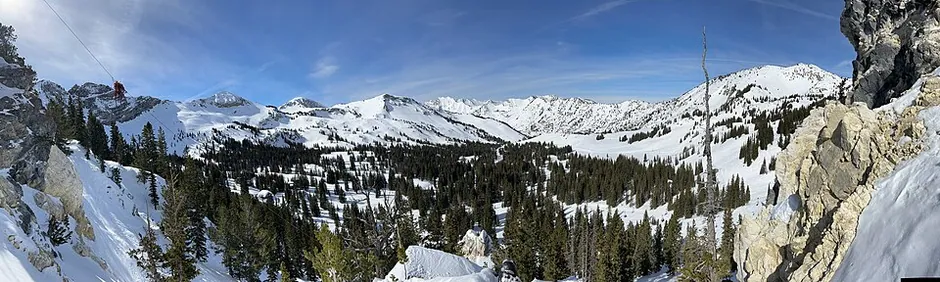
Our editorial order weighs snowfall reputation, terrain variety and what you can realistically reach from a lift. Elevation, wind and opening decisions matter more for a particular trip than any annual average. Compare the seven-day forecast with the resort’s latest lift and terrain report.
1. Alta, Utah
Alta sits at the upper end of Little Cottonwood Canyon. Its attraction is how much a storm changes the terrain you already know. The open bowls feel very different under fresh snow, and much of the pleasure is returning to a familiar lift once patrol releases more terrain. Alta is a skiers-only mountain, a decisive detail for groups with snowboarders.
2. Niseko United, Japan
Four ski areas share Mount Niseko Annupuri. That gives you several starting points and a useful choice when upper lifts are exposed. Pick the sector you want to ski first and check whether the high connections are running before setting off across the mountain. Niseko has formal gate rules for anyone leaving the managed area.
3. Grand Targhee, Wyoming
Grand Targhee occupies the western side of the Tetons. For a few days chasing snow, its compact lift base is a particular advantage. You can spend the morning skiing instead of trying to cross a sprawling linked area. The trade-off is visibility on open upper slopes during a storm. Bring a low-light lens and use the morning lift report.
4. Revelstoke, British Columbia
Revelstoke’s great strength is vertical range. The headline snowfall can be a much better description of the upper mountain than of the village beneath the gondola. Check the freezing level alongside the accumulation before choosing a day. A shorter lap high on the mountain can offer much better snow than a full descent to the base.
5. Fernie, British Columbia
Five alpine bowls give Fernie a different character depending on which sectors open. Its bowl-by-bowl status report is particularly valuable after a storm. There is little point planning around a favourite chair if the terrain you want remains closed. Groups who like trees and bowls in the same ski area have a good reason to stay several nights.
6. Mt Baker, Washington
Mt Baker is a Pacific Northwest storm mountain with two named base areas, Heather Meadows and White Salmon. The quantity of precipitation is part of the draw, but temperature makes an enormous difference to the feel of it. Look at snow level and wind as closely as centimetres, then check which base and lifts are operating that day.
7. Engelberg-Titlis, Switzerland
Engelberg has the vertical scale to turn a clear day after snow into something special. Its famous Big Five descents belong to the backcountry and include serious alpine terrain. If those descents are the reason for the trip, organise a qualified local mountain guide. For a lift-served day, use the open piste map and Titlis lift report.
8. St. Anton am Arlberg, Austria
St. Anton suits a group that wants a proper piste holiday as well as a chance of powder. There is plenty of marked skiing to fall back on while wind, visibility or closures affect other terrain. Ski Arlberg publishes both snow and avalanche information. Read those separately, and check the marked status of any ski route on the day.
9. Portillo, Chile
Portillo brings the southern winter into the picture. The basin above Laguna del Inca is open, high mountain terrain, which makes a clear spell after a storm especially appealing. Treat it as a destination worth skiing for the week in its own right. The terrain and setting will still be there if your stay falls between storms.
10. Hakuba Cortina, Japan
Cortina is the Hakuba area to watch when snow is forecast for the northern end of the valley. It has its own lift and snow report, a better guide to the day than a generic Hakuba figure. Its small footprint makes it simple to navigate, but a delayed lift matters more when there are fewer alternatives on site.
Sources
- Alta Ski Area · About the mountain
- Niseko United · The four resorts
- Grand Targhee Resort · Mountain statistics
- Revelstoke Mountain Resort · Mountain statistics
- Fernie Alpine Resort · Bowl status
- Mt Baker Ski Area · Mountain statistics
- Engelberg Tourism · The Big Five
- Ski Arlberg · St. Anton snow and avalanche report
- Ski Portillo · Planning your ski season
- Hakuba Valley · Cortina conditions
- Niseko Town · Niseko Rules
- WSL Institute for Snow and Avalanche Research · Using an avalanche bulletin